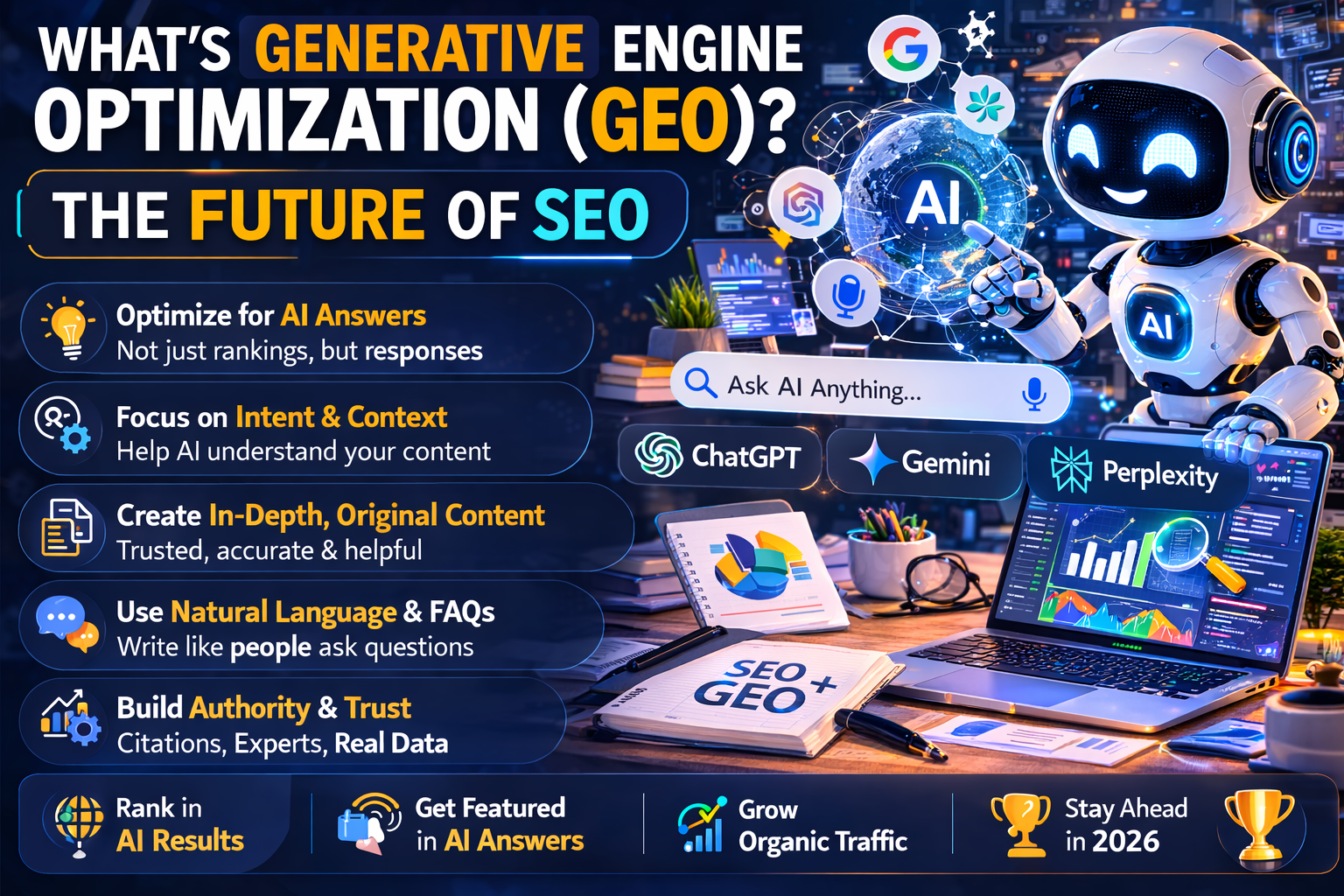
The era of the ten blue links is over. Millions of users are now turning to AI platforms like ChatGPT, Perplexity, and Google Gemini to find answers instead of browsing through traditional search engine results. This monumental shift has given rise to a new discipline: Generative Engine Optimization (GEO). If you want your website to be found in the future, mastering GEO is no longer optional.
💡 Quick Summary
- ✓GEO Definition: The practice of optimizing content so that It's cited and referenced by AI language models.
- ✓Shift in Strategy: Content must prioritize direct answers, structured data, and high-authority factual density.
- ✓Why It Matters: Traditional SEO alone won't get you cited in direct AI answers, where 60% of top-of-funnel discovery now occurs.
What's Generative Engine Optimization (GEO)?
Generative Engine Optimization (GEO) is the specialized process of optimizing website content, digital assets, and brand mentions to ensure a website is prominently featured in responses generated by AI search engines.
While Search Engine Optimization (SEO) was primarily designed to appease Google's crawling algorithms and page-rank algorithms, GEO targets the conversational models driving ChatGPT Search, Perplexity AI, Google Search Generative Experience (SGE/Gemini), and Microsoft Copilot.
Instead of trying to rank as the "first link" on a page, the goal of GEO is to be the Primary source of truth that an AI model synthesizes its answer from.
How GEO Differs From Traditional SEO
The transition from SEO to GEO requires a fundamental shift in how creators approach content. Here are the major differences:
- 🔍 Keyword Stuffing is Dead (Again):
In SEO, repeating keywords used to signify relevance. AI models use semantic understanding. They don't just count keywords; they comprehend the meaning. Using 50 related subtopics is more effective than repeating one keyword 50 times. - 📊 Fact Density Over Word Count:
Long, rambling blog posts designed to keep users scrolling (and viewing ads) are ignored by AI engines. AI craves "dense facts"—statistics, verified quotes, hard data, and structured tables. The higher your fact-to-fluff ratio, the higher your chances of citation. - 🌐 Full Brand Presence:
Google traditionally ranks domains based on backlinks to a specific page. AI models, however, are trained on the entire internet. They assess overall brand authority across Reddit, Quora, industry forums, and news sites to verify if you're a credible source.
The 4 Core Ranking Factors for AI Search Engines
To effectively implement a GEO strategy, it's important to understand what these generative engines prioritize when deciding which sources to cite in their final output.
- 1. Information Gain & Unique Insights:
If your content merely repeats what thousands of other sites say, the AI won't cite you. AI engines favor sources that offer original viewpoints, primary research, survey data, or unique expert opinions (often referred to as Information Gain). - 2. High Fact Verification:
AI models are terrified of "hallucinations" (making things up). Because of this, their retrieval engines are strongly biased towards sites with high factual accuracy, authoritative citations, and clear authorship. - 3. Unambiguous Content Structure:
Models read code, not visual layouts. Using strict, hierarchical semantic HTML (H1, H2, H3), lists, for the most part marked tables, and solid Schema.org markup removes ambiguity. This makes it easy for an AI to parse your data. - 4. Direct Answer Placement:
AI is conversational. Structuring your content to ask a question in an H2 (e.g., "What's a Neural Network?") followed immediately by a concise, authoritative 2-3 sentence answer in paragraph form dramatically increases citation likelihood.
Why Your Business Needs a GEO Strategy Today
The transition is happening faster than most anticipated. Users now prefer getting an instant, summarized answer with clickable footnote references over scanning through 10 distinct websites and dodging pop-up ads.
If your organic traffic is dropping but your traditional rankings remain stable, you're likely losing traffic to zero-click AI answers. The companies that are featured in these AI footnotes are seeing vastly higher click-through intent because the AI has implicitly endorsed them.
"By 2028, over 70% of informational search queries will result in zero-click AI responses. To survive, businesses must pivot from driving raw traffic to becoming the foundational knowledge base the AI relies upon."
How to Get Started with GEO Check-list
You don't need to throw away your SEO playbook. But you do need to upgrade it. Here's how you can start adapting to GEO today:
- Audit existing content: Remove fluff paragraphs. Front-load the most important information directly below headings.
- Add expert quotes: Include perspectives from recognized industry leaders to increase the "unique value" of the page.
- Enhance Schema Markup: Ensure every page accurately deploys Article, FAQPage, and Organization schema.
- Publish Primary Data: Instead of quoting external statistics, publish your own simple industry surveys or case studies. Data originators are almost always cited.
Ready to Dominate AI Search?
Our agency specializes in GEO readiness. We help transition your traditional SEO traffic into permanent visibility on ChatGPT, Perplexity, and Google Gemini.
Get Your Custom GEO AuditGEO Is the Future of SEO—Here's Your Next Move
Generative Engine Optimization represents the next large evolution of digital marketing. While the shift from SEO to GEO may seem daunting, the core principle remains identical: providing the highest-quality, most accurate, and most valuable information for the user. By optimizing for AI models today, you secure your brand's digital visibility for tomorrow's technology.