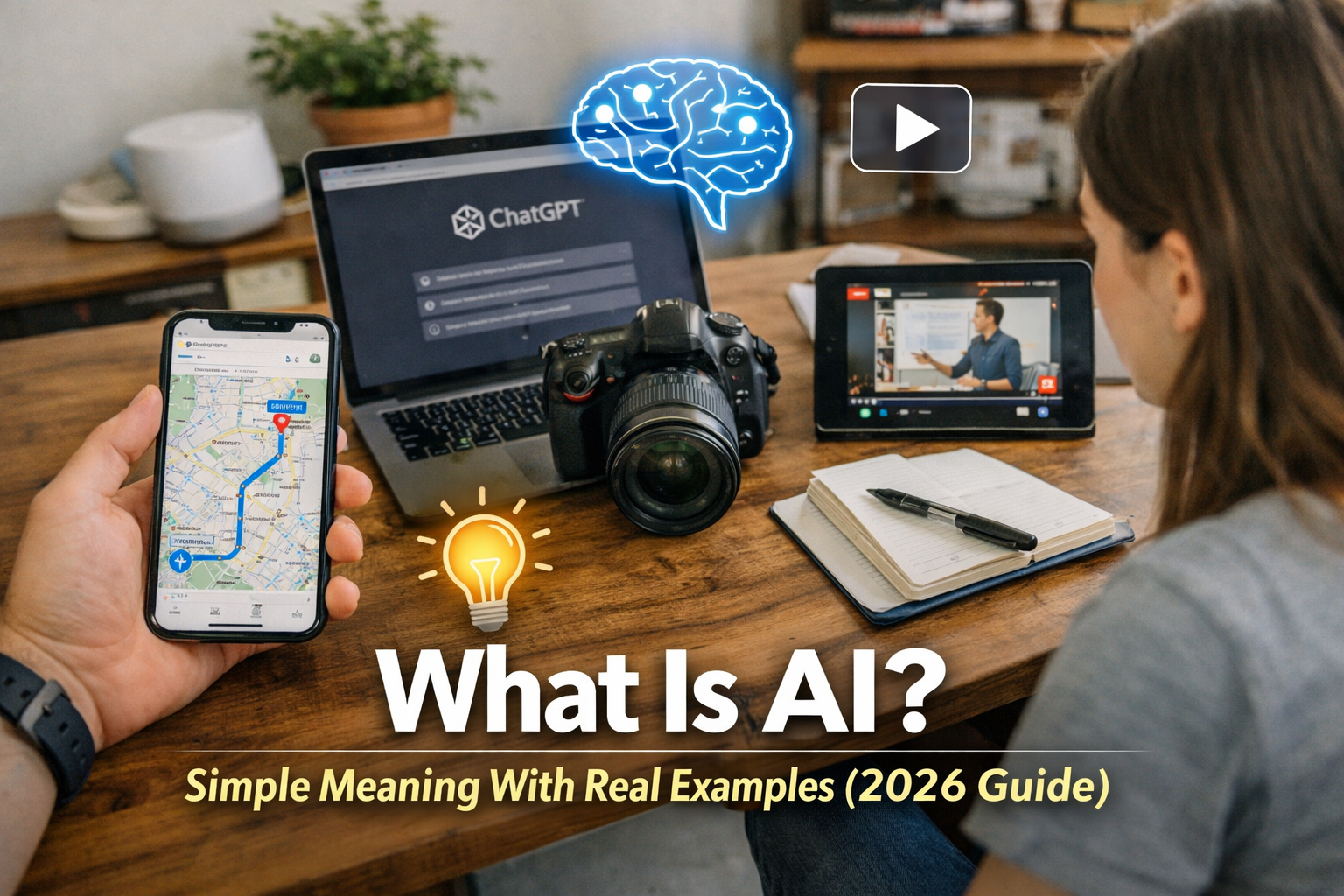
Let’s be honest: "Artificial Intelligence" sounds intimidating. It sounds like robots taking over the world. But the reality? It’s much simpler—and way more helpful. That's it. AI is already quietly working in your pocket, organizing your photos, and even helping you type faster. This guide strips away the jargon to explain what AI really is, how it works, and why it’s the most exciting tool of 2026.
💡 Quick Summary
- ✓The Core Concept: AI isn't magic; it's a computer program that learns from examples instead of just following rules.
- ✓You Use It Daily: From FaceID to Netflix recommendations, AI is already a natural part of your life.
- ✓Why It Matters in 2026: AI has evolved from a novelty to a personal assistant that amplifies your creativity and productivity.
What's AI? (The Plain English Version)
Forget the complex definitions. Artificial Intelligence (AI) is simply the science of making computers "smart."
To understand it, let’s look at the difference between a normal computer program and AI:
- 🖥️ Traditional Software (The Recipe):
It does essentially what it's told. If you tell a robot to "walk forward 10 steps," it walks. If there's a wall in front of it? It crashes. It doesn't know how to adapt. - 🧠 Artificial Intelligence (The Chef):
AI is smart enough to figure things out. If it sees a wall, it thinks, "I should stop or turn." It learns from its environment and mistakes, getting smarter every time it tries.
How Does it Actually Work?
You don't need to know code to understand the logic. Most AI follows a loop that looks a lot like how humans learn:
- 1. Training (The Classroom):
Imagine teaching a toddler what a "dog" is. You point to a Golden Retriever, a Poodle, and a Bulldog and say "Dog." AI works the same way. We feed it millions of examples so it starts to recognize patterns. - 2. Processing (The Brain):
The AI analyzes these examples using a "Neural Network"—a fancy term for a digital structure inspired by the human brain. It connects the dots: "Okay, dogs differ in size, but they all have snouts and tails." - 3. Prediction (The Test):
Now, show it a picture of a Husky (which it has rarely seen before). Based on its training, it predicts: "That looks like a dog!"
6 Examples of AI You're Using Right Now
AI isn't the future; it's the present. In fact, you probably used it 5 times before breakfast.
📱 Word & Text Correction
When your phone autocorrects a typo or Gmail suggests the end of your sentence, that’s AI predicting what you want to say.
📸 FaceID & Photos
Your phone recognizes your face to unlock. It also uses AI to fix lighting and focus every time you snap a selfie.
🎬 Netflix & YouTube
"Because you watched X, you might like Y." That recommendation engine is AI analyzing millions of users' habits to keep you entertained.
🗺️ Google Maps
It analyzes traffic speed from thousands of phones effectively "seeing" a traffic jam miles ahead and routing you around it.
💳 Fraud Protection
Banks uses AI to spot weird spending patterns. If your card is suddenly used in another country, AI freezes it to protect your money.
🗣️ Voice Assistants
Siri and Alexa use Natural Language Processing (NLP) to turn your spoken sounds into digital commands.
The 3 Levels of AI
Not all AI is created equal. Experts categorize it into three stages of evolution:
- Artificial Narrow Intelligence (ANI) - Current Reality
This is AI That's excellent at One single task. A chess-playing AI can beat a Grandmaster, but it doesn't know how to make toast. Siri, Google Search, and ChatGPT are all examples of ANI. - Artificial General Intelligence (AGI) - The Goal
This is the "Holy Grail." AGI would be a machine that can learn and understand any intellectual task a human can. It could write code, compose music, and solve physics problems with equal skill. We aren't here yet. - Artificial Super Intelligence (ASI) - The Hypothetical Future
This refers to an intellect That's much smarter than one of the best human brains in practically every field. This is the stuff of science fiction (and great scientific debate).
AI vs. Automation: The Key Difference
Automation is a dishwasher. It runs the same cycle, 100 times in a row. It doesn't care if the dishes are still dirty; it just follows the program.
AI is a self-driving car. It watches the road. It sees a child running after a ball and hits the brakes. It makes decisions based on changing data.
Why 2026 is the Year of AI
we're living through a historical shift. No joke. In 2026, AI tools have become accessible to everyone.
- Creativity for All: Tools like Midjourney and Sora allow anyone to create professional art and video.
- Productivity Boom: AI assistants draft emails, summarize meetings, and organize schedules, giving us back hours of our lives.
- Scientific Breakthroughs: AI is analyzing proteins to cure diseases faster than ever before.
FAQ: Answering Your Burning Questions
Is AI going to take my job?
It's more likely to change your job than take it. The most successful people in 2026 will be those who learn to use AI as a tool to work faster and smarter. Think of it as having a super-intern.
Is AI safe?
Generally, yes. Consumer tools have safety filters. That said, data privacy is important—almost always be careful about what personal information you share with chatbots.
Can AI feel emotions?
No. When an AI says "I understand how you feel," It's simply predicting the most polite and appropriate response based on its training data. It has no feelings, consciousness, or soul.
Don't Get Left Behind in the AI Era
The way people search is changing foundamentally. Seriously. Is your business visible on AI platforms like ChatGPT, Perplexity, and Gemini? You need a GEO (Generative Engine Optimization) strategy.
Free AI Visibility AuditAI Isn't Going Anywhere (And That's a Good Thing)
AI is here to stay, and that’s a good thing. It’s not about robots replacing humans; it’s about humans using smart tools to achieve incredible things. Whether you're using it to write a better email, find a new recipe, or diagnose a medical condition, AI is the ultimate assistant. So don't fear it—explore it!