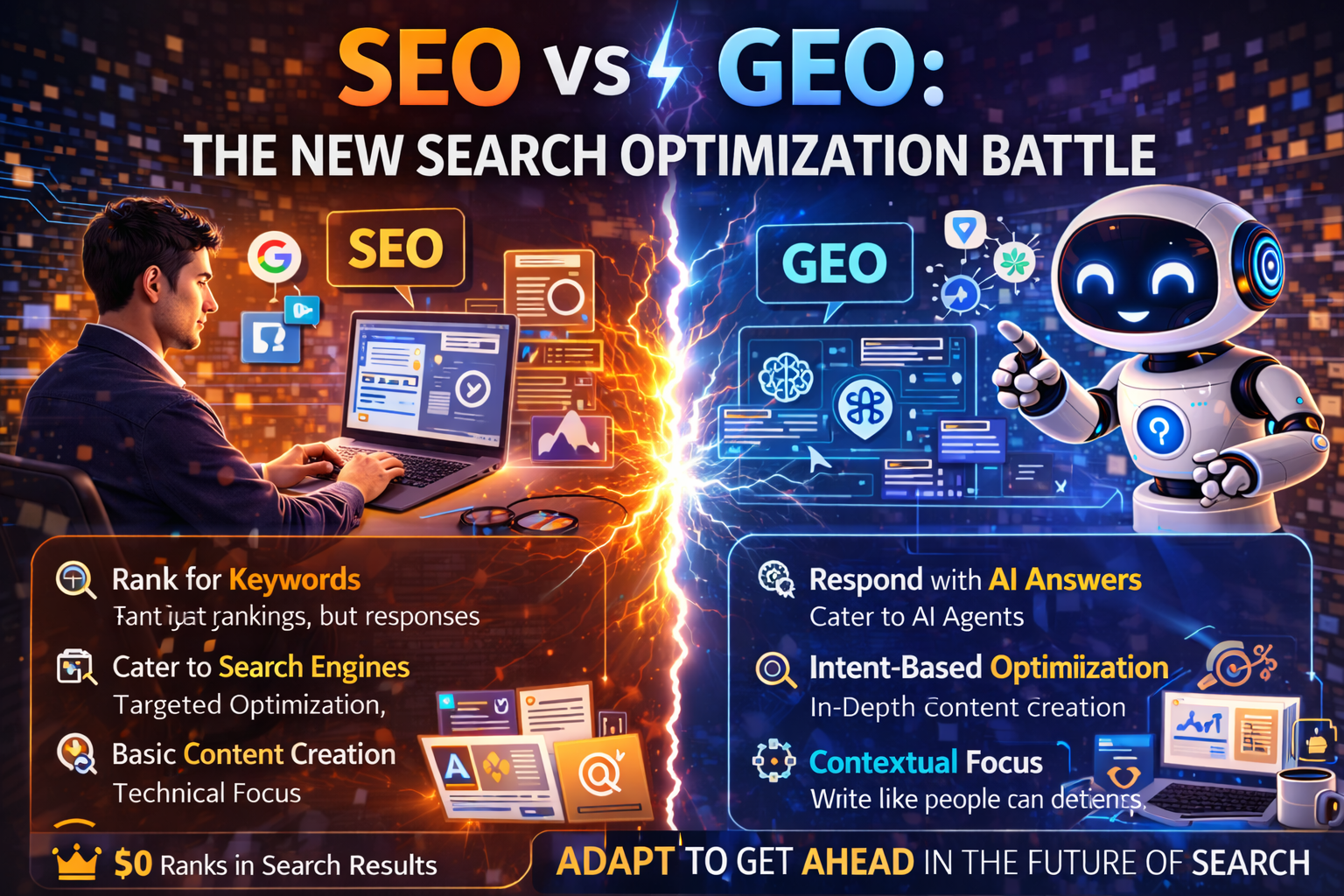
For two decades, Search Engine Optimization (SEO) was the undisputed king of digital marketing. Marketers obsessed over backlinks, keyword density, and page speed to rank "number one" on Google. But today, the game has split. The rise of AI search has sparked a new battle: SEO vs GEO. Which one actually drives revenue today?
💡 Quick Summary
- ✓SEO (Search Engine Optimization): Optimizing pages to rank as a blue link on traditional search engine results pages based on indexation and relevance.
- ✓GEO (Generative Engine Optimization): Formatting factual density and brand presence to be included as a footnote in AI-generated answers.
- ✓The Verdict: You need both today, but GEO is driving the most high-intent, bottom-of-funnel conversions.
Is Traditional SEO Dead?
The short answer is: No, SEO isn't dead. Then again, its scope has shrunk.
Traditional SEO still dominates for "transactional" or "navigational" queries. If a user searches for "Nike Air Force 1 size 10" or "Login to Facebook," they want a website link, not a conversation with a chatbot. For e-commerce product pages and direct brand lookups, traditional SEO—built heavily on site architecture and backlinks—is still the primary driver.
Then again, for Informational queries—the "How," "Why," and "What's" searches that previously drove large blog traffic—traditional SEO has been cannibalized by AI answer engines.
The Main Differences: Search Intent vs AI Action
To understand why GEO is emerging as a separate discipline, we've to look at how machines process information versus how humans read it.
- Content Length vs Factor Density
SEO: Favors 2,000+ word guides that keep users on the page longer, signaling "engagement" to Google.
GEO: Punishes fluff. AI models want you to state a fact, back it up with a clear statistic or quote, and move on. - Keywords vs Semantics
SEO: Requires explicit targeting of specific search terms and long-tail query matches.
GEO: use embedding models to understand the concept of your page. A page can be cited for an AI answer even if it doesn't contain a single exact-match keyword. - Links vs Mentions
SEO: Treats "dofollow" backlinks as currency to pass authority from one site to another.
GEO: Looks at unlinked brand mentions, sentiment analysis on review sites, and entity clustering. If your brand is highly praised on Reddit without a single backlink, an AI will still recommend you.
Which Strategy is Better for 2026?
Rather than viewing them as opposing forces, leading marketers view GEO as the natural evolution of SEO. To succeed in 2026, you can't operate a website that ignores either.
For your Service Pages and Product Listings, traditional SEO remains king. You need fast load times, excellent mobile design, optimized images, and clear calls to action.
From what I've seen, for your Blog, PR, and Thought Leadership, GEO is the top priority. AI platforms are acting as aggressive gatekeepers. To get a user out of the ChatGPT interface and onto your site, your content *must* be the citation source that the AI uses to formulate its answer.
Integrating Both for Maximum Visibility
The holy grail of 2026 digital marketing is a "Hybrid Optimization Strategy." Here’s how you layer GEO tactics over a strong SEO foundation:
- Maintain Technical SEO: Just because AI reads the content doesn't mean your server architecture can be broken. A fast, crawlable site is required for both humans and AI bots.
- Restructure Content for RAG: Place a concise "TL;DR" summary at the top of every long-form article. Use clear sub-headings structured as questions that users ask AI.
- Create Proprietary Data: If you're the main source of a specific survey or dataset on the internet, every AI engine will be forced to cite you when answering questions about that data.
Need Help Transitioning?
Stop losing your hard-earned traffic to AI summaries. We optimize existing web content to ensure it becomes the primary citation source for all major AI search engines.
Book a GEO ConsultationSEO vs GEO: Which One Should You Prioritize?
The battle between SEO and GEO isn't a fight to the death—it's an evolution. While traditional SEO drives transactional clicks on standard search engines, GEO secures your visibility and brand authority inside the AI conversational models that are rapidly becoming the internet's primary layer. Adopt both, and watch your business thrive.