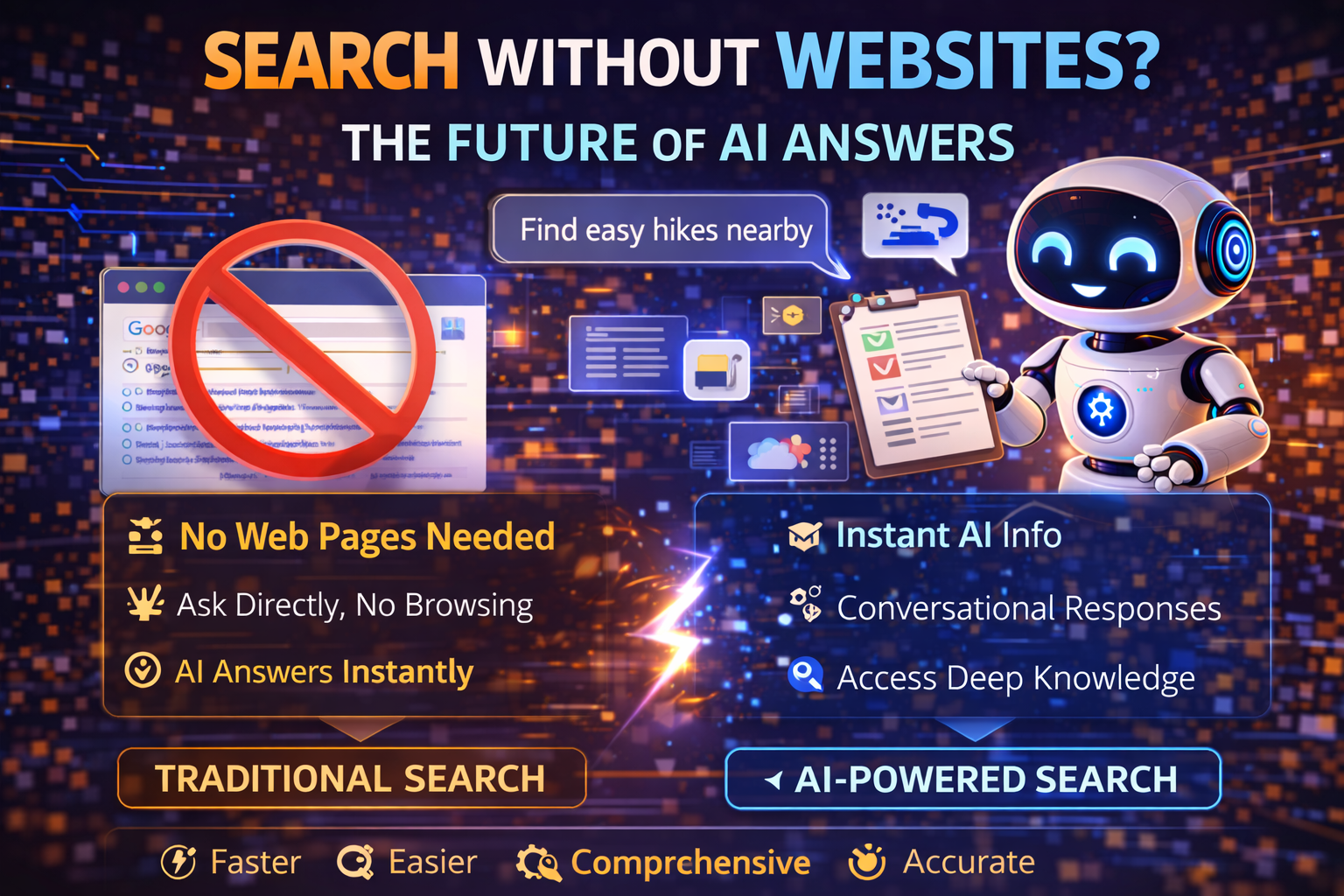
The ultimate realization of a search engine is an oracle: you ask a question. And it gives you the exact answer. You don't have to scroll, click, or read through recipe blogs to find the ingredients. But if AI engines provide perfect answers directly in the Search Engine Results Page (SERP), what happens to websites? Welcome to the era of Zero-Website Search.
💡 Quick Summary
- ✓Zero-Click Evolution: Before AI, zero-click searches accounted for over 60% of all queries (e.g., weather, calculators). Generative AI expands this to complex topics.
- ✓The Citation Economy: If almost no one clicks on your website, your new KPI is how often the AI cites your brand as the source of its knowledge.
- ✓Experience Beats Information: AI can summarize facts. It can't replicate unique opinions, deep experiences, or exclusive data.
Are Websites Dying?
The short answer is: Commoditized websites are dying.
From what I've seen, if your website's entire business model is answering "What time is the Superbowl?" or "How to boil an egg," you've been replaced by a Language Model. Large Language Models (LLMs) can instantly synthesize public knowledge without forcing a user to navigate through pop-up ads and introductory fluff.
That said, websites functioning as software, communities, or original data publishers are thriving. AI can't replace the backend of a SaaS tool, the raw statistics of a primary research firm, or the nuanced opinions of an industry veteran.
The "Citation Economy"
As clicks diminish, a new economy emerges: The Citation Economy. When Perplexity, ChatGPT, or Google SGE generates an answer, they provide footnote links to the sources they used.
Being "Number 1" no longer means being the first blue link. It means being the primary citation that forms the foundation of the AI's answer. When your brand is cited by an AI, it acts as a large signal of indisputable authority to the end user. They might not click your website, but they trust your brand recommendation.
How to Survive Zero-Website Search
If traffic is going to drop across the board, how do businesses generate revenue from search?
- Lead Capture over Ads: Stop relying on high-volume traffic to generate ad revenue. Focus on high-intent content that captures email addresses and builds private audiences.
- Original Data: Conduct your own studies, run your own surveys, and publish proprietary data. If you own the main dataset on a specific topic, the AI must cite you to provide a complete answer.
- Aggressive Brand Marketing: Move from generic informational search to Navigational search. You want users to tell their AI, "Find the answer according to [Your Brand]."
- Optimize for "Knowledge Panels": Ensure your brand is an established entity. Claim your Google Business Profile, maintain a Wikipedia or Wikidata presence, and ensure your PR is flawless.
Dominate the Citation Economy
If AI engines are going to write the answers, they need to cite someone. Make sure it's you. Inovixa architects your content specifically to be extracted, summarized, and prominently cited by generative search engines.
Optimize Your Brand CitationsIs Your Website Ready to Be Read by AI Agents?
we're approaching a reality where websites are treated as databases by AI agents. Users won't read your designed web pages—their AIs will read them, synthesize the data, and present it back. To survive, you must abandon commoditized content and focus ruthlessly on Information Gain: providing data, experience, and authority that no LLM can generate on its own.