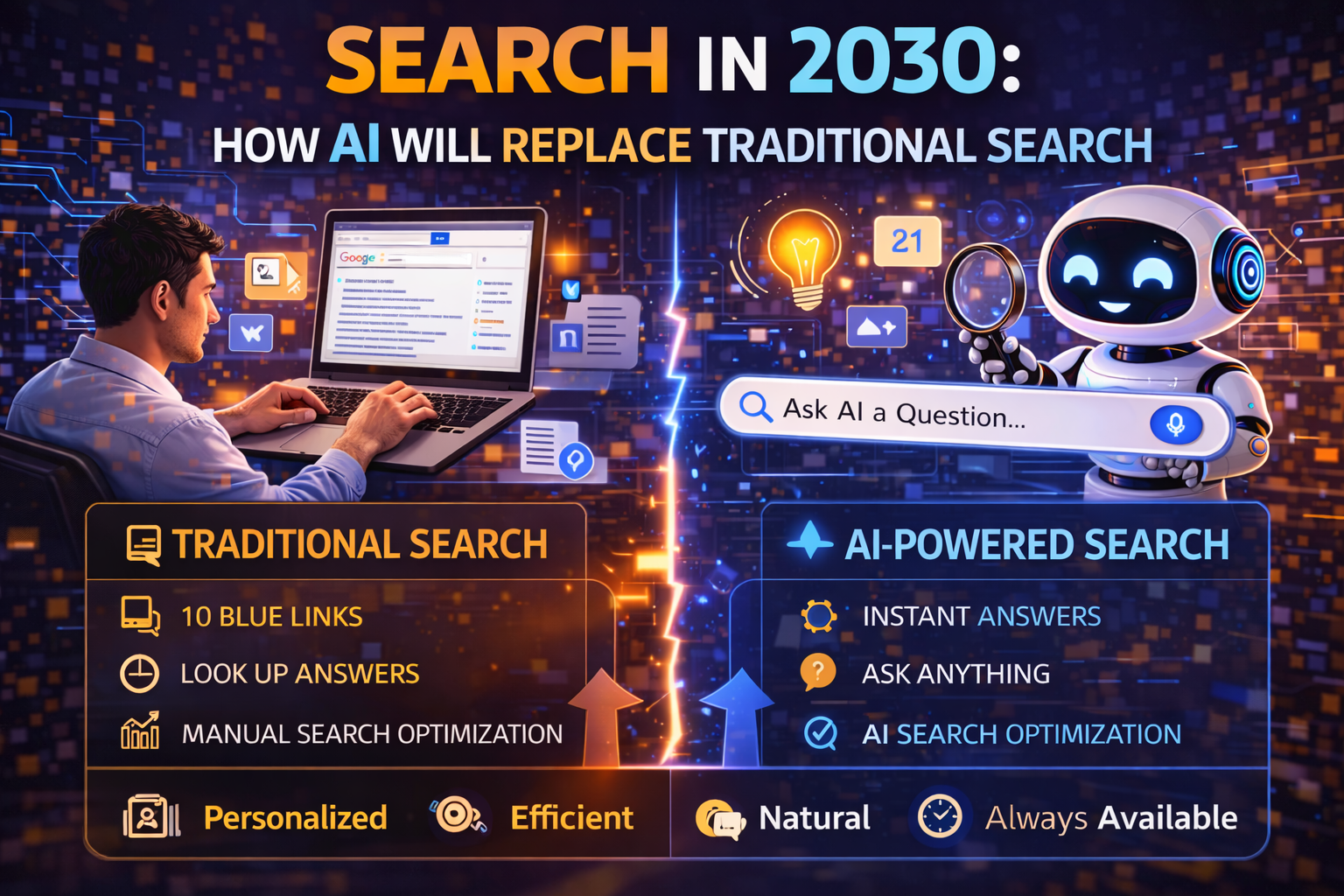
For twenty-five years, the internet operated on a single premise: you type a keyword, you get ten blue links. And you hunt for the answer. By 2030, that model will be extinct. The future of search isn't a directory of websites; It's a personalized, multimodal intelligence interface. Let’s explore what the internet will look like in 2030.
💡 Quick Summary
- ✓The End of the "Link Tax": Users will no longer click through three different websites and accept cookies to find an answer. The AI will synthesize the final answer directly in the interface.
- ✓Action-Oriented Search (Agents): You won't search "best flights to Tokyo." you'll tell your agent, "Book me the most comfortable flight to Tokyo under $1,000," and the AI will execute the transaction.
- ✓Multimodal Queries: Text will become the secondary input method. Voice, physical camera scanning, and bio-metrics will drive the majority of search queries.
From Retrieval to Synthesis
Traditional search engines are retrieval systems. They act like a librarian, pointing you to the aisle where you might find the book you need.
From what I've seen, the search engines of 2030 are synthesis systems. They act like a top-tier researcher who goes to the library, reads 50 books for you, extracts the necessary data, and writes you a personalized executive summary.
This breaks the economic model of the current internet. If users rarely have to leave the search interface, websites lose display ad revenue and affiliate clicks. Simple as that. For businesses, the focus shifts away from "driving pageviews" to "becoming the cited source" in the AI's synthesized answer.
The Rise of Autonomous Agents
By 2030, the biggest shift will be moving from Informational Search to Action-Oriented Search via autonomous agents.
Currently (in 2026), AI search engines like ChatGPT Search provide answers. No joke. But by 2030, they will have "Agency." They will be integrated directly with your wallet, your calendar, your email, and your CRM.
Typical 2030 Query: "Find a highly-rated plumber near me who has availability tomorrow morning, book an appointment, and provide them a temporary door code." The AI handles the whole logistics pipeline.
Zero-UI and Ambient Computing
The way we interface with search is changing. Keyboards and screens are large friction points. In 2030, search will be "Ambient."
Through smart glasses (like advanced iterations of Meta Ray-Bans), neural interfaces, and almost always-listening home environments, search will happen continuously in the background. If you're cooking and look at a strange ingredient in your fridge, you'll verbally ask, "What's this, and what can I make with it?" The glasses scan the item, run a multimodal AI search, and project a recipe directly into your field of vision. Seriously. No typing required.
Is Your Business Ready for 2030?
If you're still only optimizing for 10 blue links on a desktop screen, you'll be invisible in 5 years. Inovixa prepares your brand infrastructure for autonomous agents, voice search, and AI synthesis.
Secure Your Digital FutureWhat This Shift Means for Your Business Today
In my experience, the transition from traditional search to AI synthesis is as significant as the transition from the yellow pages to Google. By 2030, search will be invisible, proactive, and action-oriented. Brands that restructure their data now—implementing advanced schema, API connectivity, and Generative Engine Optimization—will become the foundational data layer for the personal AI assistants of tomorrow.