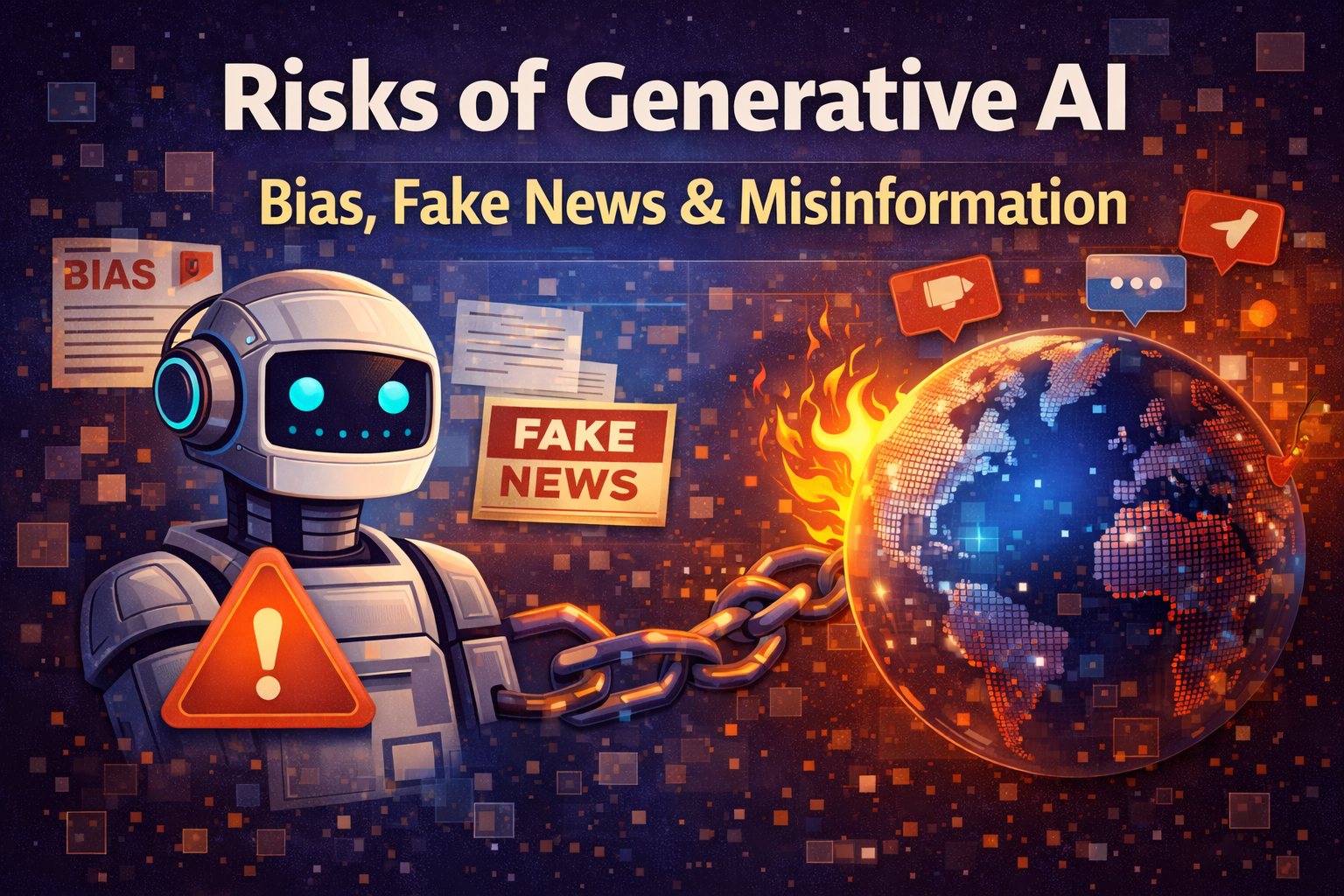
While the creative visual powers of Generative AI dominate headlines, researchers and global regulators are sounding loud alarm bells. Beyond the obvious threat of basic job displacement, generative models introduce an new spectrum of societal and structural dangers. The core risks of 2026 involve the systemic, automated pollution of human truth through Algorithmic bias, automated fake news, and large-scale misinformation. Here's essentially What's at stake.
1. The Collapse of Ground Truth (AI Hallucinations)
The core architectural danger of highly capable language models like GPT-4 is their significant, unwavering linguistic confidence. These models are specifically structured practically to predict the most statistically probable next word in a sentence. they're not designed as factual databases.
This flaw leads directly to severe AI Hallucinations. When an AI hallucination—a stated, fabricated political or medical fact—is published online, It's automatically indexed by Google Search. Subsequent AI models then unknowingly scrape that exact hallucinated data as factual training data, creating a feedback loop referred to by researchers as "Model Collapse."
2. Algorithmic Bias at Scale
Because these language and image models initially ingested billions of text documents randomly published across the internet over the past thirty years, they successfully ingested nearly every ugly human prejudice encoded within that historical data.
- Biased Hiring Algorithms: An AI programmed to automatically scan corporate resumes was famously discovered to silently down-rank applicants possessing female-oriented traits purely because the AI practically deduced that historical corporate executives were statistically overwhelmingly male.
- Racial Facial Recognition: Early generative image models consistently rendered prompts asking for a "criminal" specifically using dark skin tones, while rendering "CEOs" as exclusively Caucasian males.
- Medical Diagnostics Bias: AI models trained primarily on data from wealthy Western hospitals often fatally misdiagnose patients of different ethnic backgrounds due to strict gaps in biological training data.
3. The Industrialization of Fake News & Misinformation
before Generative AI, successfully running a malicious foreign disinformation campaign required a large budget to hire thousands of human workers (troll farms) to manually type deceptive political comments online.
From what I've seen, today, a single bad actor can legally spin up an open-source LLM, script it to invent two million highly polarized, emotionally charged political tweets an hour, and automatically deploy them across Twitter and Facebook, simulating real grassroots human outrage. This obliterates the fundamental democratic mechanism of public consensus.
For an explicit breakdown of the specific visual medium driving this political disinformation, read our detailed guide: Deepfake Technology Explained and Real Dangers.
Global Regulatory Responses
Governments are urgently scrambling to legislate reality. The European Union's monumental AI Act specifically targets these foundational models, fiercely mandating that companies formally watermark their AI output and practically audit their core matrices for implicit racial bias before launching high-risk applications.
Frequently Asked Questions
Can an AI be legally sued for defamation?
In my experience, this is a large ongoing global legal gray area right now. If ChatGPT invents a fictional story accusing a real living human being of embezzlement, American courts are battling over whether the tech company that built algorithms holds the core liability, or if Section 230 platform protections legally shield them.