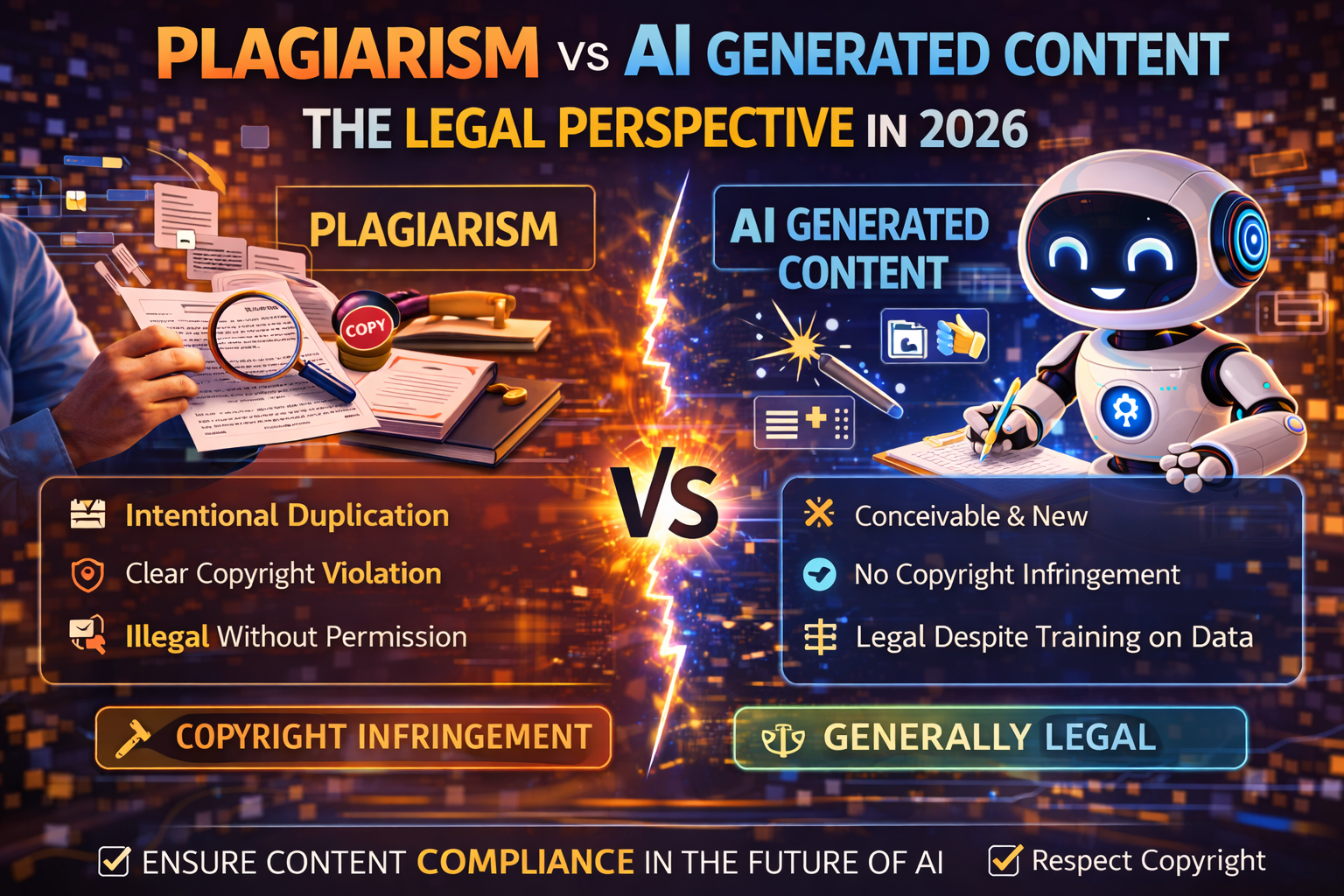
When you prompt ChatGPT to write an article for your company blog, who owns it? Are you violating copyright laws? As AI integration becomes standard practice across digital marketing today, misunderstanding the difference between plagiarism and algorithmic generation can result in legal liability. You need to know essentially how the courts define AI content today.
💡 Quick Summary
- ✓AI isn't considered Plagiarism by default. LLMs synthesize information; they don't copy-paste. Standard AI generation passes Copyscape easily.
- ✗There's NO Copyright Protection. The US Copyright Office ruled that raw AI-generated content can't be copyrighted because it lacks a "human author."
- ✓The 15% Rule: If a human substantially edits and re-arranges the AI output, the final "hybrid" document can be copyrighted.
Is AI Content Technically Plagiarism?
Plagiarism is defined as taking someone else's specific words or ideas and passing them off as your own.
When ChatGPT writes a paragraph explaining how SEO works, It's not scraping a specific blog post and stealing the text. Simple as that. It uses complex statistical probability to predict the next word in a sequence based on billions of parameters. Because It's generating net-new text, it almost rarely triggers traditional plagiarism checkers like Copyscape or Turnitin's classic database.
That said, There's a concept taking hold today called "Conceptual Plagiarism" or "Idea Laundering." While the exact words are new, the core thesis or proprietary framework might be stolen without attribution. If you ask an AI to summarize a paid substack newsletter and publish the summary on your blog, you're legally culpable.
The Copyright Dilemma
The biggest risk for enterprise companies relying on AI content isn't getting sued for plagiarism; it's the inability to protect their own IP.
In a landmark ruling, the U.S. Copyright Office declared that works created "without any creative contribution from a human actor" can't be granted copyright protection.
If you publish 1,000 raw AI articles on your website, any competitor can legally copy-paste those exact articles onto their own website. You can't file a DMCA takedown notice because you don't own the copyright.
How to Secure Copyright on AI Content
To actually own the blog post you publish, you must prove "Substantial Human Intervention." While There's no hard mathematical percentage, legal experts generally refer to this as the "Cyborg Approach":
- The AI generates a raw structural draft.
- A human editor rearranges the structure.
- A human adds unique proprietary data, images, and quotes.
- The human performs a heavy stylistic rewrite.
The resulting composite document is copyrightable because human creativity was the driving force behind the final product.
Defending Against AI Scraping (GEO)
As a content publisher, your primary concern should be AI Search Engines (like Perplexity and ChatGPT Search) scraping your human-written content to generate answers for their users.
While many publishers rushed to implement `robots.txt` blocks against `GPTBot`, the reality right now is that blocking AI crawlers makes you invisible. The new standard is Generative Engine Optimization (GEO)—structuring your content so that when the AI scrapes it, you're legally cited with a clickable hyperlink in the AI's response. Without proper schema markup and structured data, your IP will be ingested and monetized by the AI platforms without you receiving a single click of referral traffic.
Protect Your Website's IP
Are AI search engines using your content without citing you? We implement advanced GEO strategies to ensure your brand receives attribution and referral traffic from large language models.
Talk to a GEO ExpertWhat This Means for Your Company's AI Content Policy
The current legal framework surrounding AI demands that companies use AI as a co-pilot, not an autopilot. Ensure every piece of content published under your brand has undergone substantial human review. This isn't just best practice for Google rankings—it's the main way to legitimately own your company's intellectual property.