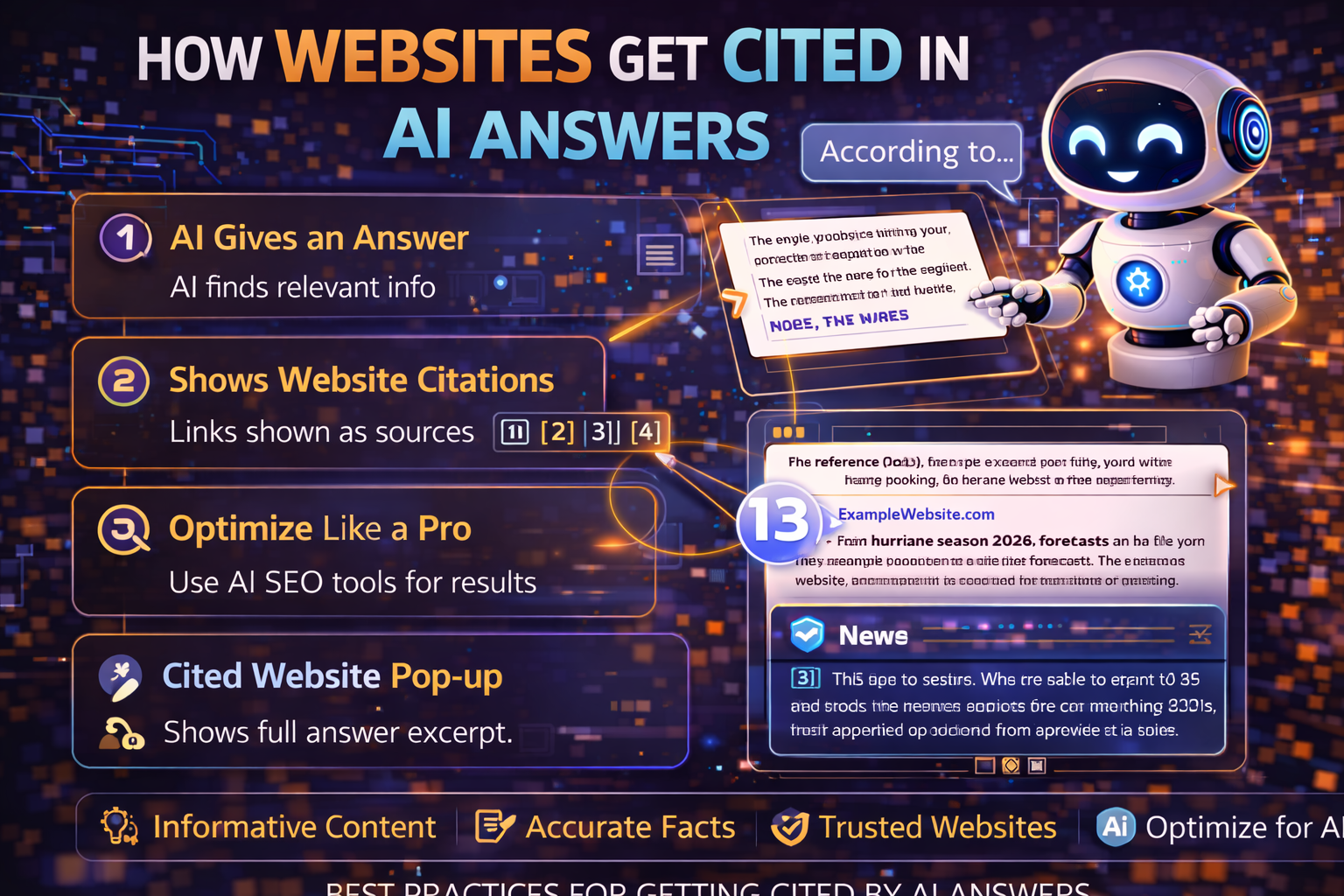
In the era of traditional SEO, the primary goal was to rank as the #1 blue link on a search engine results page (SERP). Today, the ultimate prize is the AI Footnote Citation [1]. When an AI generates an answer and cites your website as the source of its facts, you capture the highest-intent traffic on the internet. But how essentially does an AI decide which websites to cite?
💡 Quick Summary
- ✓Information Gain is Required: AI won't cite your website if it simply regurgitates what 10 other websites say. You must provide unique data or novel viewpoints.
- ✓Format for Extraction: Tables, bulleted lists, and bolded statistics are astronomically more likely to be cited than long, narrative paragraphs.
- ✓Semantic HTML Matters: Machine scrapers rely on clean code architecture to understand the hierarchy of your content.
The New Gold Standard: The AI Footnote
When a user queries Perplexity or ChatGPT with web access, the system reads multiple articles simultaneously. It then writes a paragraph synthesizing that information, dropping footnotes like [1], [2], and [3] at the end of specific sentences.
For a business, acquiring that footnote means you've been verified as an authoritative source by an unbiased machine. Click-through rates on these citations routinely outperform standard organic search results by 200% to 300% because the user already trusts the AI's recommendation.
What Triggers a Citation? Information Gain
The single biggest mistake marketers make in 2026 is publishing "me-too" content. If a user asks "What's one of the best CRM software?" and your blog post simply lists Salesforce, HubSpot, and Zoho with generic descriptions, an AI will never cite you. Why? Because the base LLM already knows that information.
AI only reaches out to the live web—and then cites sources—when it hits a gap in its knowledge. Simple as that. To get cited, you must provide Information Gain. This takes several forms:
- Real-Time Data: Updated pricing tiers that changed yesterday, stock availability, or breaking news.
- First-Party Statistics: "According to a survey of 500 of our customers, 62% prefer remote work." Since this data only exists on your site, the AI is practically forced to cite you if the user asks about remote work trends.
- Unique Expert Quotes: Direct quotes from recognized subject matter experts that can't be found elsewhere.
Formatting Content for the Embedder
AI bots don't "read" a website like a human does. They parse HTML, extract the text, chunk it into paragraphs, turn those chunks into math (embeddings), and compare them to the user's query.
The "Snackable Fact" Rule: AI models prefer to extract concise, definitively stated facts. If you bury a key statistic in the middle of a 300-word paragraph filled with marketing adjectives, the parser will likely skip it.
From what I've seen, instead, use formatting that tells the AI, "Here's the data, ready to copy."
- Use Markdown tables to compare features or pricing. AI models are trained heavily on tabular data and parse it.
- Use bulleted lists for "Pros and Cons" or "Top 5" roundups.
- Bold key metrics so they stand out in the text chunk.
A Technical Checklist for Getting Cited
Content is only half the battle. If the AI's web scraper can't physically parse your page, you won't receive a citation. Ensure your technical team addresses the following:
- Semantic HTML Limits Hallucinations: Stop putting main content inside
<div class="content">. Use native HTML5 tags like<article>and<section>. No joke. This prevents the scraper from accidentally pulling in your sidebar widgets as factual text. - H2/H3 Tag Structure as NLP Triggers: Your subheadings should match essentially what a user would type into an AI prompt. Instead of "Pricing Details," use an H2 that says: "How Much Does X Cost in 2026?" The closer the H2 matches the query, the stronger the retrieval match.
- Paywall Configurations: If you use gated content or lead-gen popups that obfuscate the text on page load, RAG scrapers will bounce. You must allow AI user-agents (like
ChatGPT-UserorGoogleOther-Image) to bypass the gate via your robots.txt or server configuration if you want the citations.
Are You Losing Citations?
We run deep algorithmic analyses to find essentially where your website is failing to be cited by Perplexity, Copilot, and ChatGPT. let's fix your markup and content structure.
Get an AI Citation AuditHow to Actually Get Cited by AI (Your Action Steps)
Getting cited by an AI isn't about tricks; It's about density, clarity, and unique value. Stop writing fluffy 2,000-word SEO articles that say nothing new. Start publishing dense, data-backed reports structured with clear semantic HTML. Make it easy for a machine to extract your brilliance, and the citations will roll in.