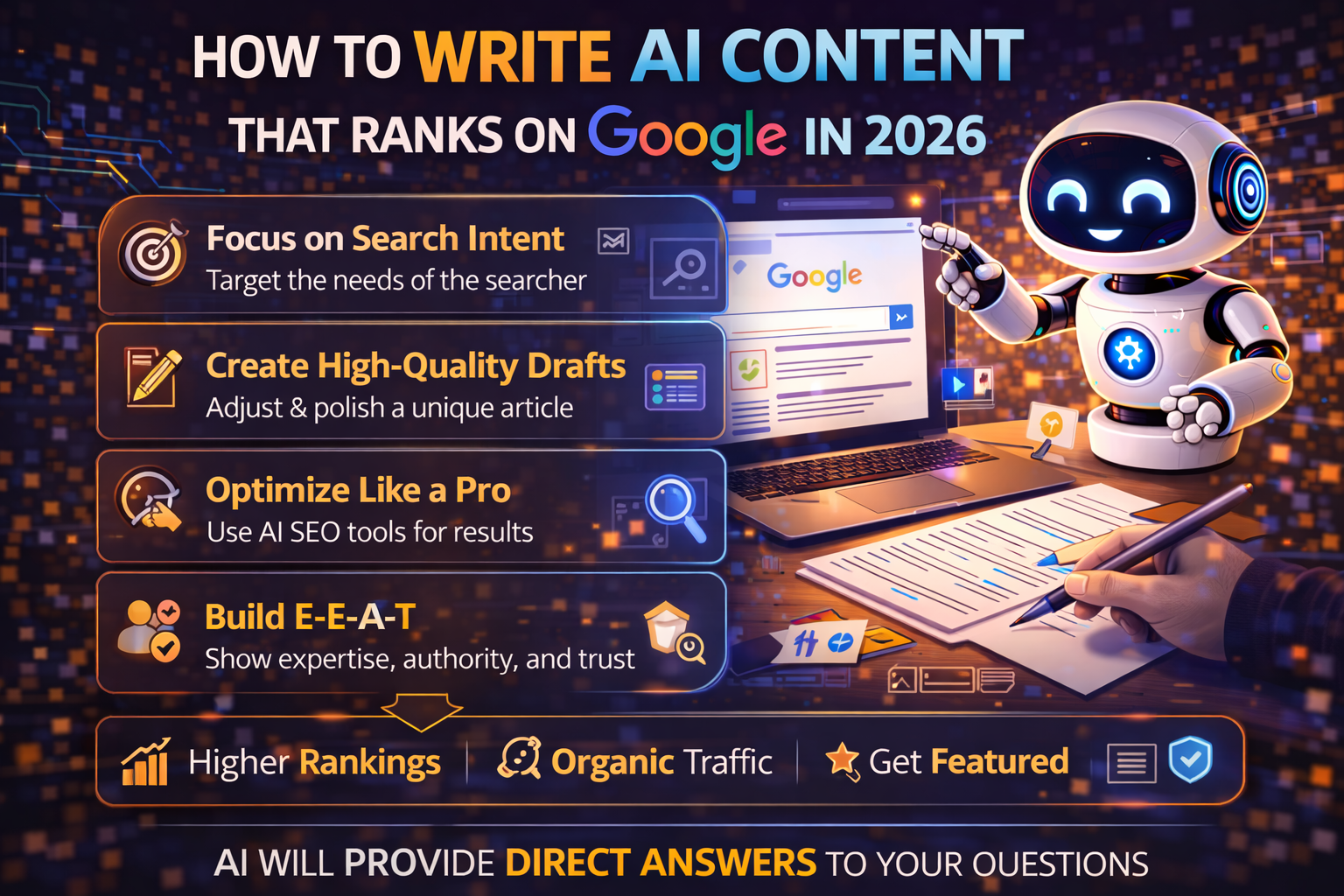
Can you still rank on Google using ChatGPT? The answer is yes—but the rules have changed. Today, raw, unedited AI output gets buried by the algorithm almost immediately. Then again, when you use a strategic "Cyborg" approach, AI content can outrank even legacy industry blogs.
💡 Quick Summary
- ✓Google's Stance: Google doesn't penalize AI; it penalizes low-quality, spammy content that lacks original value.
- ✓Information Gain: Your AI content must include first-party data, quotes, or opinions that the base LLM couldn't possibly generate on its own.
- ✓The Editing Requirement: rarely publish the first draft. At least 30% of an AI-generated article needs manual human rewriting to succeed.
Does Google Actually Penalize AI Content?
Let's clear the air: Google's official documentation states that they reward "high-quality content, however It's produced." There's no algorithmic parameter that automatically deletes a post simply because it was written by GPT-4.
What Google does penalize is "scaled content abuse." If you use an automated script to spin out 5,000 generic articles a day targeting low-competition keywords without any editorial review, the Helpful Content Update (HCU) algorithms will de-index your website.
The problem with raw AI content isn't that it's synthetic. the problem is that It's inherently average. Language models work by predicting the most statistically likely next word. By definition, raw AI output is the mathematical average of everything already written on the internet. It brings nothing new to the table.
Step 1: Prompting for "Information Gain"
To rank today, your content must possess "Information Gain"—the inclusion of facts or perspectives not found elsewhere on page one of the SERPs. Because an AI can't have unique life experiences or opinions, you must inject them into the prompt.
Bad Prompt: "Write a 1000-word blog post about the benefits of running shoes."
Great Prompt: "Write an outline for a blog post about running shoes. That's it. I'll provide you with five direct quotes from my interview with our lead podiatrist, Dr. Smith, warning against maximalist cushioning. Integrate these quotes naturally. Also, include our proprietary company data showing that 60% of our ultra-marathon clients prefer a 4mm drop. Write in an authoritative but contrarian tone."
By forcing the AI to structure its output around your unique, first-party data, the resulting article instantly becomes a unique asset rather than a generic summary.
Step 2: Structuring for Readability & NLP
AI tends to write in large, structured paragraphs that are exhausting for a human to read on a mobile device. Google's user experience metrics track "dwell time" (how long a user stays on a page). If users encounter a "wall of text" and bounce back to the search results, your rankings will tank.
- Break up paragraphs: Ensure no paragraph is longer than 3-4 sentences.
- Use semantic lists: Instruct the AI to format pros/cons or step-by-step guides using markdown bullet points and numbered lists. This satisfies Natural Language Processing (NLP) models.
- Add tables: If comparing features or pricing, prompt the AI to generate a markdown table. Tables are heavily favored for triggering Google Featured Snippets.
Step 3: The "Cyborg" Editing Process
The most important step in writing AI content that ranks is ironically the human element. We call this the "Cyborg Strategy"—AI handles the heavy lifting of structure and drafting, while the human editor injects personality, empathy, and E-E-A-T (Experience, Expertise, Authoritativeness, Trustworthiness).
Your editing checklist must include:
- Killing the "Fluff" Intros: AI almost almost always begins with sweeping, generic statements like, "In 2026..." Delete this immediately. Start with a hook.
- Fact Verification: AI hallucinates. rarely rely on an LLM for statistics. Double-check every metric and manually hyperlink to the primary source.
- Inserting First-Person Analogies: Add a sentence like, "When we implemented this framework for a client last week, it reminded me of..." AI can't manufacture genuine human anecdotes.
Scale Content Without Getting Penalized
Are you terrified of Google's Helpful Content Update? We provide specialized AI prompt engineering and "Cyborg" editing services to scale your traffic safely.
Audit Your AI ContentCan AI Content Still Rank on Google? Yes—Here's the Catch
Writing AI content that ranks on Google is possible, but the "push-button-publish" era is dead. To succeed, you must view the AI as your junior researcher and drafter, not your Editor-in-Chief. By injecting proprietary data into your prompts and rigorously human-editing for empathy and flow, you can use AI to scale your publishing output without risking algorithm penalties.