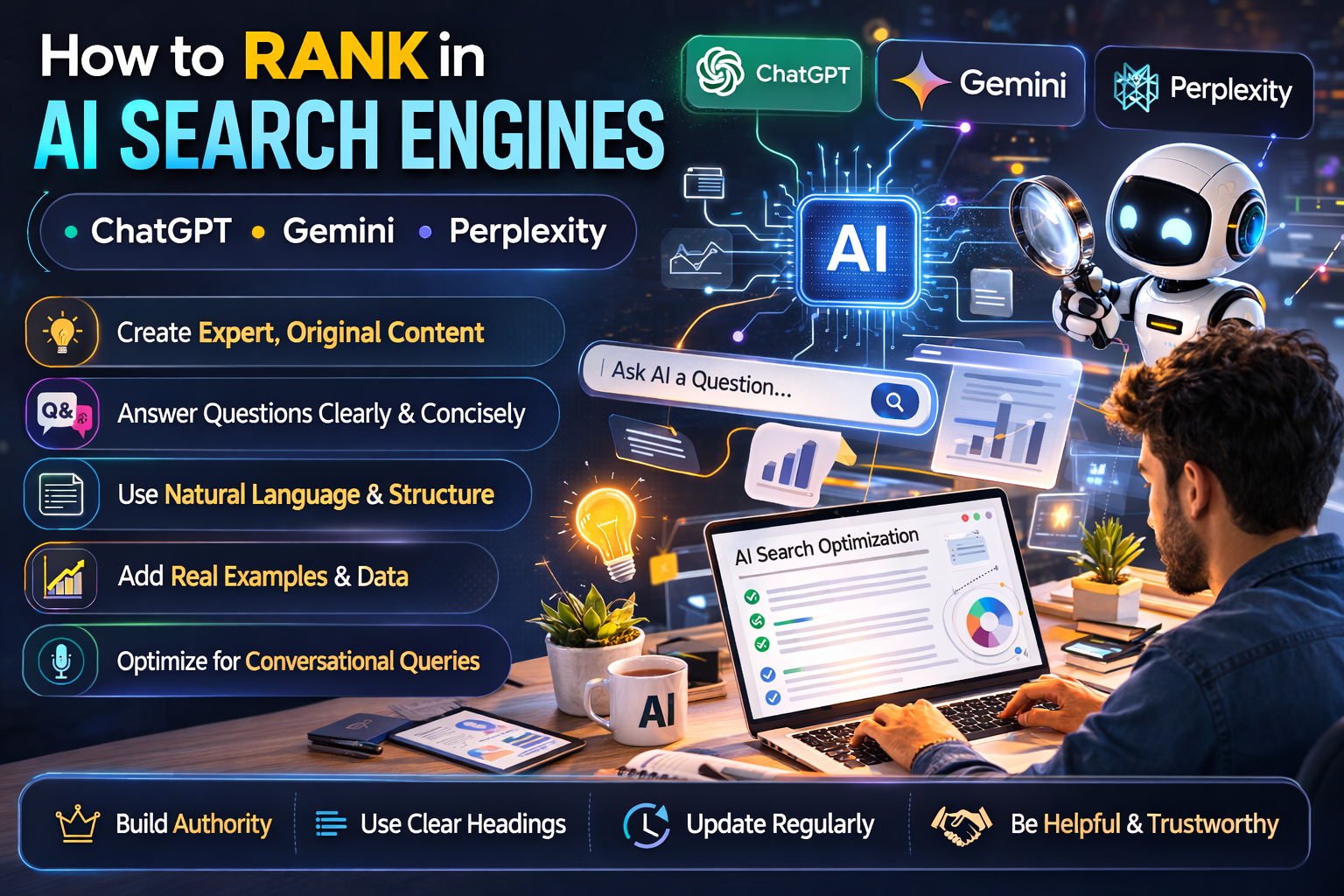
Generative AI search engines have officially broken the Google monopoly. Today, millions of users ask ChatGPT, Perplexity, and Google Gemini for recommendations rather than typing keywords into a search bar. Getting listed as a footnote or citation in these AI outputs is the new standard of digital visibility. In this guide, we reveal the specific strategies needed to "rank" and get cited in each of the big three AI platforms.
💡 Quick Summary
- ✓ChatGPT Optimization: Relies heavily on Bing search index and brand sentiment across third-party authorities.
- ✓Google Gemini (SGE): Highly dependent on Google Core Updates, EEAT signals, and structured data.
- ✓Perplexity AI: Favors highly structured lists, academic sources, real-time news, and objective data.
The Shift from "Ranking" to "Being Cited"
Before we look at individual platforms, it's vital to unlearn the concept of "Position 1." In AI Search, There's no page two. There's only the synthesized answer.
From what I've seen, rather than optimizing for algorithms to list your link, you're optimizing for RAG (Retrieval-Augmented Generation). This means you must frame your website's content so for the most part and factually that an AI pulls your specific sentence into its generated answer, appending your website link as the source footnote.
1. Ranking on ChatGPT (OpenAI)
ChatGPT integrates a built-in search functionality primarily powered by Bing's search index. When a user asks a current-events or fact-based query, ChatGPT searches the internet, reads the top results, and synthesizes them.
- 🔍 Optimize for Bing Webmaster Tools:
Since ChatGPT heavily relies on Bing, your first step is ensuring your site is indexed and ranked in Bing. - 💬 Conversational Formatting:
ChatGPT likes to answer in paragraphs. Structure your content with exact question headings (e.g., "What's one of the best CRM for small business?") followed by a precise, 40-word summary before diving into deeper details. - 🗣️ Brand Sentiment Coverage:
ChatGPT checks Reddit, Quora, and G2 to verify if a product is actually good. Ensure your brand has positive, organic mentions off-site, as the model synthesizes public consensus.
2. Ranking on Google Gemini / SGE
In my experience, google's AI Overview (formerly SGE) sits directly at the top of Google search results. This is perhaps the most valuable place to be cited, as it captures the majority of traditional search traffic.
- EEAT is Mandatory:
Gemini applies Google's strict Experience, Expertise, Authoritativeness, and Trustworthiness guidelines. Your content must for the most part display author bios, factual citations, and organizational transparency. - Use Schema Markup heavily:
Google relies on Schema to understand context. UseFAQPage,Article, andVideoObjectschema. If Gemini understands your data structure It's much more likely to feature you in the AI snapshot. - Provide Quick-Scan Lists:
Gemini frequently outputs bulleted and numbered lists for comparisons or "How-To" steps. Ensure your web pages contain clean, nested HTML lists that the AI can easily scrape and present.
3. Ranking on Perplexity AI
Perplexity is an answer engine built around citations. It behaves somewhat like an automated academic researcher. So, it has a strong bias toward deeply factual, authoritative content.
To optimize for Perplexity, focus on the following:
- Academic & Data-Driven Language: Minimize marketing fluff. Perplexity skips over promotional language. Present data logically, citing academic papers, official statistics, and primary sources in your text.
- Update Frequency: Perplexity values recency highly. Regularly update your best content with current year statistics and recent industry developments.
- Clear Definitions: Perplexity frequently provides direct definitions in the first sentence. Having a "Definition:" section highlighted for the most part in your articles is a major boost.
The Universal Strategy: Semantic Structuring
Regardless of which AI engine you're targeting, the foundation of GEO remains the same: Semantic Clarity.
AI models read the code of your page. If your page relies heavily on complex visual JavaScript to load content, the AI might miss it completely. Ensure that your core content sits in simple, clean HTML (<p>, <h2>, <table>, <ul>). When an AI model scrapes your page to build an answer during a live search, it needs to process the information in milliseconds. The simpler the structure, the faster it can verify your data, leading to a higher probability of citation.
Are You Invisible to AI?
Don't lose your market share to competitors who are already optimizing for ChatGPT and Gemini. We offer specialized GEO services to integrate your brand directly into the AI age.
Talk to a GEO ExpertYour AI Search Ranking Game Plan
Ranking in AI search engines requires pivoting away from traditional keyword-stuffed SEO toward providing direct, factual, and highly readable answers. By formatting your website specifically for machine understanding and focusing on genuine brand authority elsewhere on the web, your business can successfully secure top positions in standard AI platforms. Start auditing your most critical pages today.