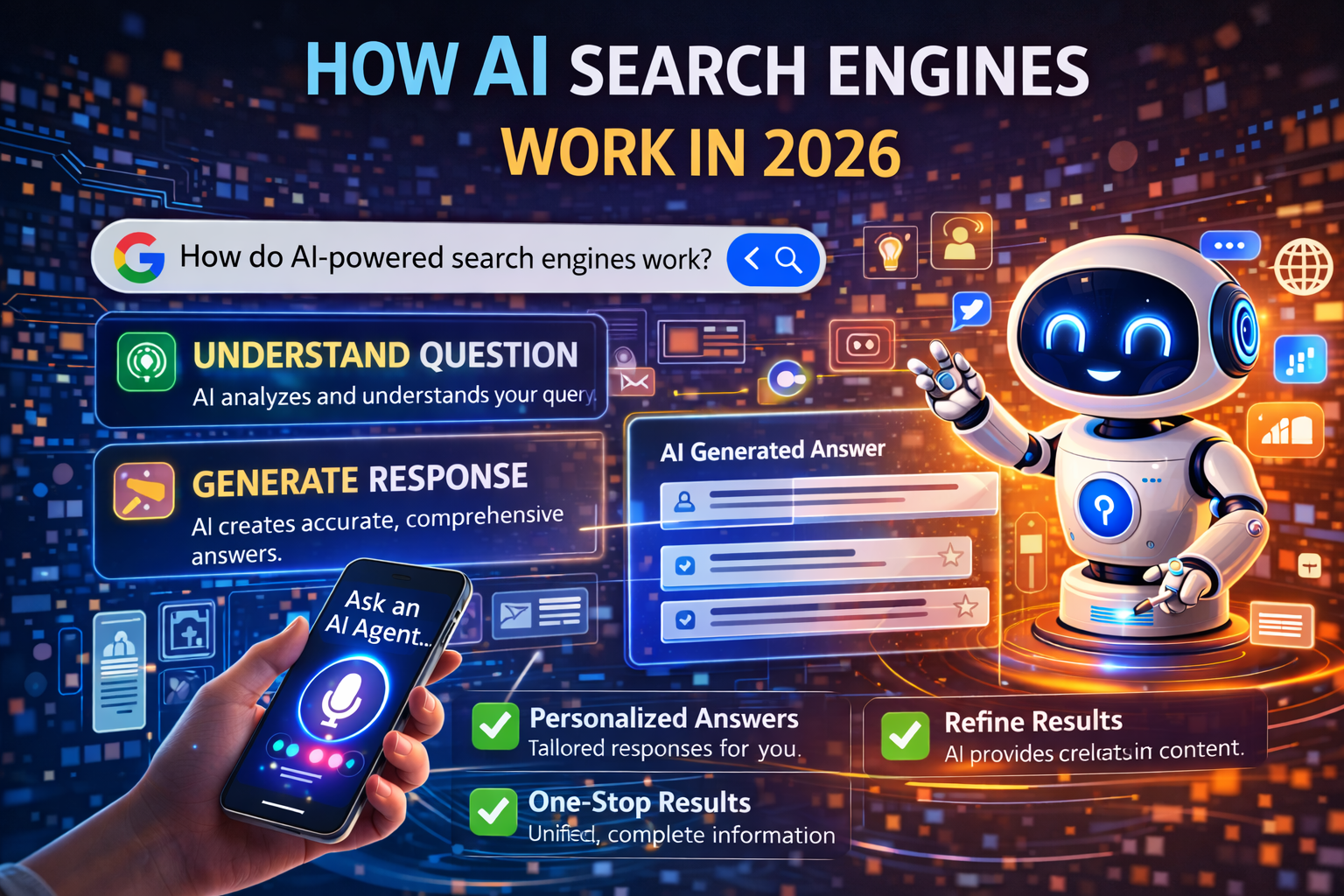
When you type a query into a traditional search engine, a large database matches your keywords against an index of websites. But when you ask an AI engine like Perplexity or ChatGPT, a much more complex process occurs in milliseconds. To effectively rank today, you must understand the architecture of how these AI search systems operate behind the scenes.
💡 Quick Summary
- ✓Training Data vs. Live Browsing: AI engines use pre-trained knowledge for base logic, but perform live web scraping (RAG) for accurate, current facts.
- ✓RAG Architecture: Retrieval-Augmented Generation is the specific technology that allows AI to read websites and construct cited answers.
- ✓Semantic Vectors: Content is scored based on mathematical proximity to the user's intent, not just keyword matching.
The Two Brains of an AI Search Engine
Traditional search engines essentially have one "brain"—the indexed database. AI search engines operate using two distinct systems working in parallel.
Brain 1: The Base LLM (Parametric Memory)
This is the foundational Large Language Model (like GPT-4, Claude, or Gemini). It has been trained on trillions of words. It knows grammar, logic, history, and general facts up until its training cutoff date. If you ask it "Why is the sky blue?", it doesn't need to search the web. the answer is already baked into its neural network.
Brain 2: The Search/Retrieval Network
Since the base LLM can't know yesterday's news or real-time business changes, it acts as a controller. When asked a live question (e.g., "What are the top SEO agencies in 2026?"), the LLM writes an underlying search query, sends it to a traditional search index (like Bing API or Google Search API), fetches the top 5-10 articles, reads them instantly, and synthesizes the answer.
RAG (Retrieval-Augmented Generation) Explained
The process described above is known as RAG. RAG is the most important acronym in the modern search world. It's the bridge between a static AI model and a live website.
How a RAG pipeline works step-by-step:
- Query Intent Analysis: The AI interprets the user's exact intent and turns it into one or multiple search parameters.
- Vector Search (Retrieval): The engine searches an index for content That's practically identical in meaning (semantic relevance) to the query.
- Parsing and Reading: The AI downloads the text from the top results. It ignores styling widgets, large CSS files, or heavy scripts—it only reads the HTML text content.
- Synthesis (Generation): The AI aggregates the facts across the sources, checks them against each other for consensus, and generates a conversational response, attaching footnote links to the sources it pulled the facts from.
How AI Selects Its Sources (The "Ranking" Factor)
If an AI search engine pulls from 10 live websites but only cites 3 in its final answer, how does it choose the winners? It comes down to three primary filters:
- 1. Information Density:
If Website A has 2,000 words but only 2 facts, and Website B has 300 words with 10 facts structured, the model will prioritize pulling from Website B. That's it. AI hates parsing "fluff." - 2. Consensus and Verification:
AI models attempt to prevent hallucinations. If your website makes a bold claim that contradicts the other 9 results, the AI is likely to exclude your site to maintain safety, unless your site possesses an really high domain trust score (.gov,.edu, highly authoritative news). Let's call this the "Consensus Penalty." - 3. Layout and Parser Friendliness:
If the AI can't determine where the main article ends and the footer navigation begins due to messy HTML tags, the scraper will fail. Simple as that. And you won't be cited. Semantic HTML5 tags (<article>,<section>,<h1>) act as a map for the RAG scraper.
Optimizing for Embeddings
From what I've seen, finally, you must understand vector embeddings. No joke. Instead of reading words as text, AI models convert sentences into multi-dimensional arrays of numbers called "vectors." Words with similar meanings exist close together in this mathematical space.
In my experience, when creating digital content, you don't merely want to optimize for a specific keyword phrase. you want to optimize for a "Concept Cluster." Your articles should thoroughly cover all subtopics, synonyms, and logical follow-up questions related to a subject so that your page's vector "footprint" aligns with the user's intent vector.
Optimize Your Site Architecture
Is your website's HTML invisible to AI scrapers? We provide full-stack technical audits to ensure RAG pipelines can read and cite your content.
Get Technical GEO SupportHow to Use This Knowledge to Get Cited by AI
The magic of AI search engines is ultimately a combination of parametric storage and Retrieval-Augmented Generation (RAG). By understanding that the AI is effectively an automated researcher rapidly scraping your site for verifiable, dense facts, you can reverse-engineer your content publishing strategy. Format for the parser, write for the embeddings, and the citations will follow.