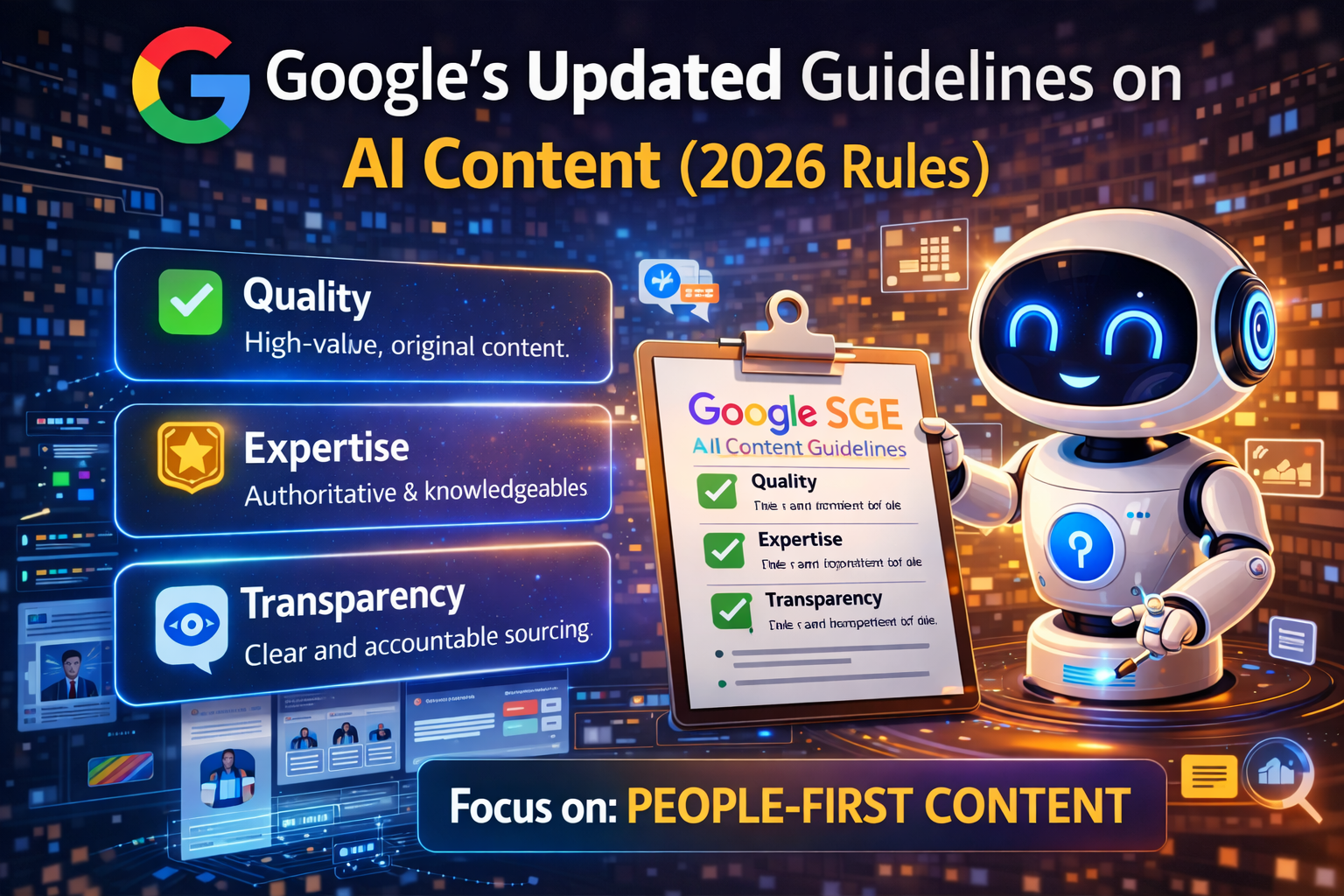
"Will Google penalize my site if I use AI?" This is the single most common question we receive. Over the last three years, Google has dramatically updated its stance—from punishing spammy AI to rewarding well-researched, AI-assisted writing. Here's essentially what Google's 2026 guidelines say about AI content.
💡 Quick Summary
- ✓Google doesn't penalize AI. The official stance is that Google rewards high-quality content however It's produced.
- ✗Google Penalizes Manipulation. Producing large amounts of AI content solely to manipulate search rankings (Programmatic Spam) is penalized.
- ✓E-E-A-T is Mandatory. AI content that lacks demonstrating Experience, Expertise, Authoritativeness, and Trustworthiness won't rank in YMYL (Your Money, Your Life) niches.
The Big Shift: "For People, Not Search Engines"
When ChatGPT first launched, the SEO industry flooded Google with millions of low-quality, automated articles. Google responded with the large Helpful Content Updates (HCU). As of 2026, the Helpful Content system isn't an update anymore—it's baked directly into the core ranking algorithm.
Google states: "We focus on the quality of content, rather than how content is produced."
They acknowledge that AI is a tool, just like grammar checkers or typewriters. If AI helps you produce a more full, readable, and helpful guide for a human being, Google wants to rank it.
What Constitutes "Spam" in 2026?
While Google accepts AI writing, they've updated their Spam Policies to specifically target "Scaled Content Abuse."
Scaled content abuse is when many pages are generated for the primary purpose of manipulating Search rankings and not helping users. This abusive practice is typically focused on creating large amounts of unoriginal content that provides little to no value to users, no matter how it's created.
Examples of what Google will de-index:
- Location Scrape-and-Spin: Using AI to spin the same article 500 times with different city names ("Best plumber in Austin," "Best plumber in Dallas," etc.) without adding local value.
- Meaningless Summaries: Scraping the top 5 ranking pages and having AI write a summarized amalgamation of them, adding zero new original information to the internet.
- Auto-generated Affiliate Sites: Thousands of AI product reviews where the author has for the most part rarely touched or tested the physical product.
The Necessity of E-E-A-T
If AI can write grammatical informational content, how does Google decide who ranks #1? They use E-E-A-T (Experience, Expertise, Authoritativeness, and Trustworthiness).
From what I've seen, the "Experience" metric was added recently to combat AI. An AI can't experience anything. So, content that demonstrates first-hand experience is given large priority. If you write an AI article recommending a software tool, you must include custom screenshots, your own data, and your subjective opinion on using it. If the page is just a regurgitation of the tool's marketing copy (which is what AI generates), it will be suppressed.
Do You Need to Disclose AI Usage?
Google recommends adding a disclaimer or an "Author Byline" indicating AI involvement, but It's Not heavily penalized if you don't—unless you're in the News, Finance, or Medical niches.
In those YMYL (Your Money, Your Life) sectors, lacking transparency about AI generation can lead to a manual action (penalty). A small disclaimer at the bottom stating, "This article was drafted with the assistance of AI and rigorously reviewed by our editorial team," is considered best practice.
Recovering from an AI Penalty?
Did your website traffic drop to zero during the last Helpful Content Update? We specialize in auditing, humanizing, and restructuring websites to recover Google rankings and align with 2026 guidelines.
Get an SEO AuditGoogle's Bottom Line on AI Content
The rules are simple. Don't use AI to spam. Use AI to create one of the best possible resource on the internet for the user's search intent. If your page provides high value, is easy to read, and contains unique insights, Google will rank it regardless of whether a human or an algorithm typed the initial draft.