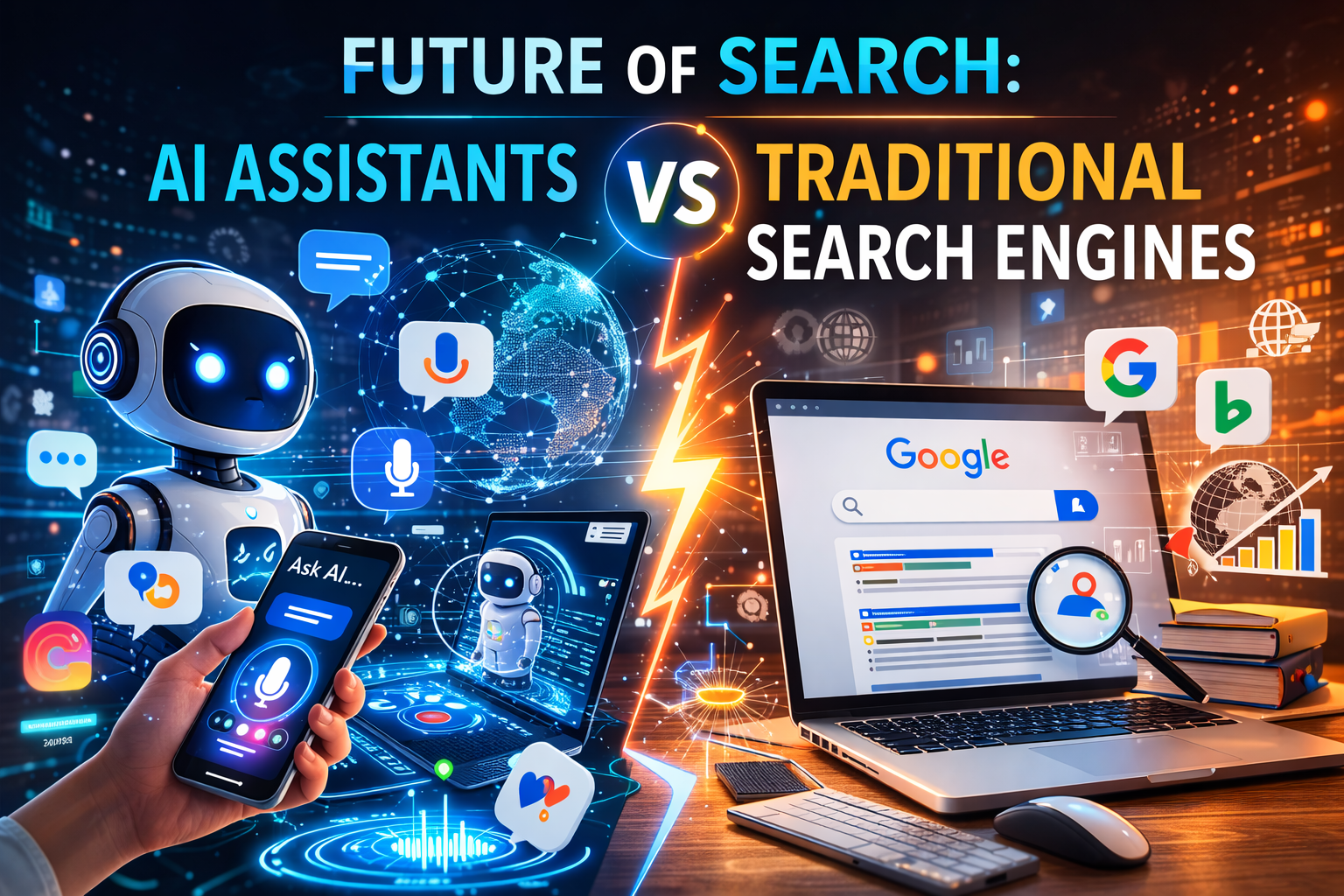
The evolution of the internet has moved in distinct phases. First, we had web directories. Then we had algorithmic search engines. Today, we're witnessing the final transition: from traditional "search" to delegating tasks to autonomous AI assistants. If you want your business to be discovered today and beyond, you must understand this fundamental shift in user behavior.
💡 Quick Summary
- ✓Aggregators (Traditional Search): They provide a list of links and force the user to do the reading and synthesis. Ideal for simple navigation.
- ✓Synthesizers (AI Search): They read the links for the user and provide a summarized, cited answer.
- ✓Executives (Autonomous Agents): The future is AI that doesn't just find the data, but actually executes the task (e.g., booking the flight or buying the software).
a major change: From Search to Action
To grasp why the market is changing, consider the "Cost of Labor" for the user.
From what I've seen, when a user queries a Traditional Search Engine:
1. They think of a keyword.
2. They scan a list of 10 blue links.
3. They ignore the first 3 sponsored links.
4. They open 4 tabs.
5. They read 4 different articles, mentally aggregate the facts, and draw a conclusion.
In my experience, when a user queries an AI Assistant (like Perplexity or ChatGPT):
1. They ask a complex question in natural language.
2. The AI performs steps 2 through 5 instantly and provides the final paragraph.
The user's cognitive load is reduced by 90%. Once users experience this frictionless workflow, they rarely return to traditional search for informational queries.
Phase 1: Traditional Search Engines (The Aggregators)
Google and Bing (pre-2023) fall into this category. they're vast, brilliant indexing machines. They connect intent to a destination. While their market share for informational queries is dropping, they're still highly relevant for "action-oriented" queries: "Buy Nike Shoes," "Plumber near me," or "Facebook login."
Optimization Strategy: Classic Technical SEO, Core Web Vitals, Local SEO, and Ecommerce keyword targeting.
Phase 2: AI Assistants (The Synthesizers)
we're currently in this phase. That's it. Perplexity, ChatGPT Search, and Google Gemini fall here. These platforms act as an intelligent layer placed on top of the traditional aggregators.
Optimization Strategy: Generative Engine Optimization (GEO). you're optimizing to become the "footnote." Your content must be dense, factual, and formatted for a RAG (Retrieval-Augmented Generation) pipeline to extract and cite.
Phase 3: Autonomous Agents (The Executives)
The bleeding edge of 2026 is moving beyond synthesis into execution. we're seeing the rise of "Action Agents."
Instead of asking an AI, "Find me a cheap flight to London," and receiving a list of options to click, the user says, "Book me the cheapest window seat flight to London leaving next Friday under $600." The AI agent then logs into the airline, uses stored payment credentials, navigates the web interface, and returns with the booking confirmation.
Optimization Strategy: API readiness. Simple as that. For an autonomous agent to interact with your business, your website must either have clean, accessible architecture (so the agent's web-driver can click buttons), or you must expose your services via an open API that the AI can converse with.
The Future for Marketers
If your entire digital strategy relies on users clicking a blue link in Google to slowly read your 2,000-word blog post, your traffic will approach zero by the end of the decade.
The future belongs to businesses that understand how to feed data to machines. This means:
- Transitioning from a "Pageview" metric to a "Citation/Mention" metric.
- Cleaning up site architecture so bots can parse meaning without confusion.
- Moving away from generic SEO writing and toward creating proprietary data that AI is practically forced to cite.
Is Your Business Ready for AI Agents?
Here's the thing — don't get left behind as the internet transitions from Search to Synthesis. We build lasting GEO strategies that ensure AI assistants find, understand, and recommend your brand.
Future-Proof Your BrandWill AI Assistants Kill Traditional Search?
Traditional search engines won't disappear. They will remain useful for simple directory lookups and highly transactional e-commerce behavior. But for knowledge work, learning, research, and high-level decision-making, the transition to AI Assistants is permanent. If you adapt your digital presence to serve these new AI Gatekeepers, the new era of search will drive more qualified, high-intent leads to your business than the old era ever could.